

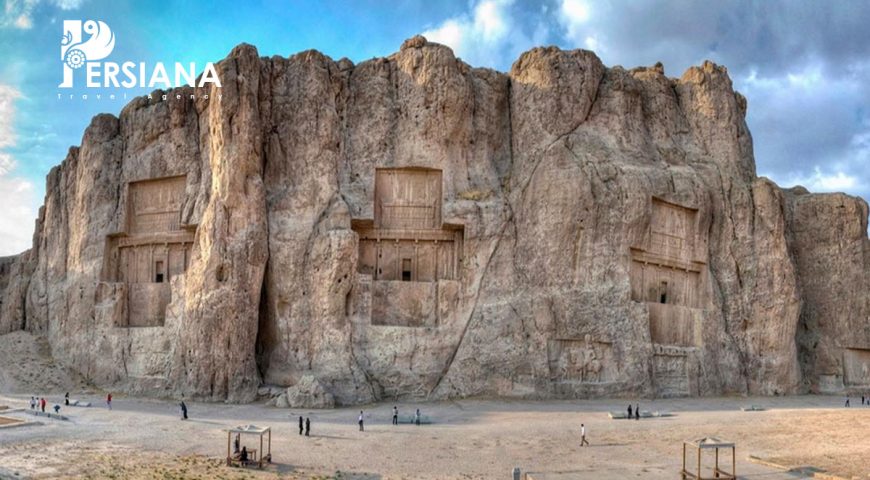
Naqsh e Rustam
Naqsh e Rustam is a very famous historical monuments which consists the tombs of several Achaemenid kings, including Darius the Great and Xerxes, bas-reliefs from important Sassanid events, a building called the Kaaba of Zoroaster and a ruined relief from the Elamite period. Persiana Travel and Tourism Agency invites you to read this article and get familiar with amazing Naqsh e Rustam.
Introduction of Naqshe Rustam
Naqsh e Rustam is a historical complex located 6 km north of Persepolis in Fars province of Iran. This complex is located in Hajiabad mountain, north of Marvdasht. Naqsh e Rustam is located in the center of ancient Iran and in the northeast of this region, the ancient capital of Cyrus the Great, Pasargadae. In Naqsh e Rustam, there are works from the three different period: Elamite period 600 to 2000 BC, the Achaemenid period 600 to 330 BC and the Sassanid period 224 to 651 AD. The tombs of several great Achaemenid kings, including Darius, Xerxes, Ardashir I and Darius II can also be seen in Naqsh e Rustam.
In addition to these tombs, there are very beautiful reliefsin Naqsh e Rustam which are from the coronation of Ardeshir Babakan and also the victory of Shapur I in a war against the Roman emperor. Another important building in Naqsh e Rustam is the Zoroastrian Kaaba. This building of Naqsh e Rustam was used to store the Avesta book and the court treasure, but it also had other users for whom detailed information is not available.
In general, the buildings and figures in Naqsh e Rustam include the bas-relief of the Elamite period which is the oldest bas-relief in Naqsh e Rustam, Achaemenid buildings including the Kaaba of Zoroaster, Achaemenid tomb, the tomb of Darius the Great (Crown Prince and successor of Darius the Great), the tomb of Ardashir I (grandson of Darius the Great and son of Xerxes) and the tomb of Darius II. Other monuments of Naqsh e Rustam are related to the Sassanid period including Ahuramazda and Ardeshir Babakan, Shapur’s victory over the Roman emperors, Bahram II and courtiers, the lithograph of Bahram II, Anahita and Narsi, the battle of Hormuz II and the bas-relief of the half-full Azarnarseh, the battle of Shapur II and the shaved plate are without any figure.
Achaemenid Tombs in Naqsh e Rustam
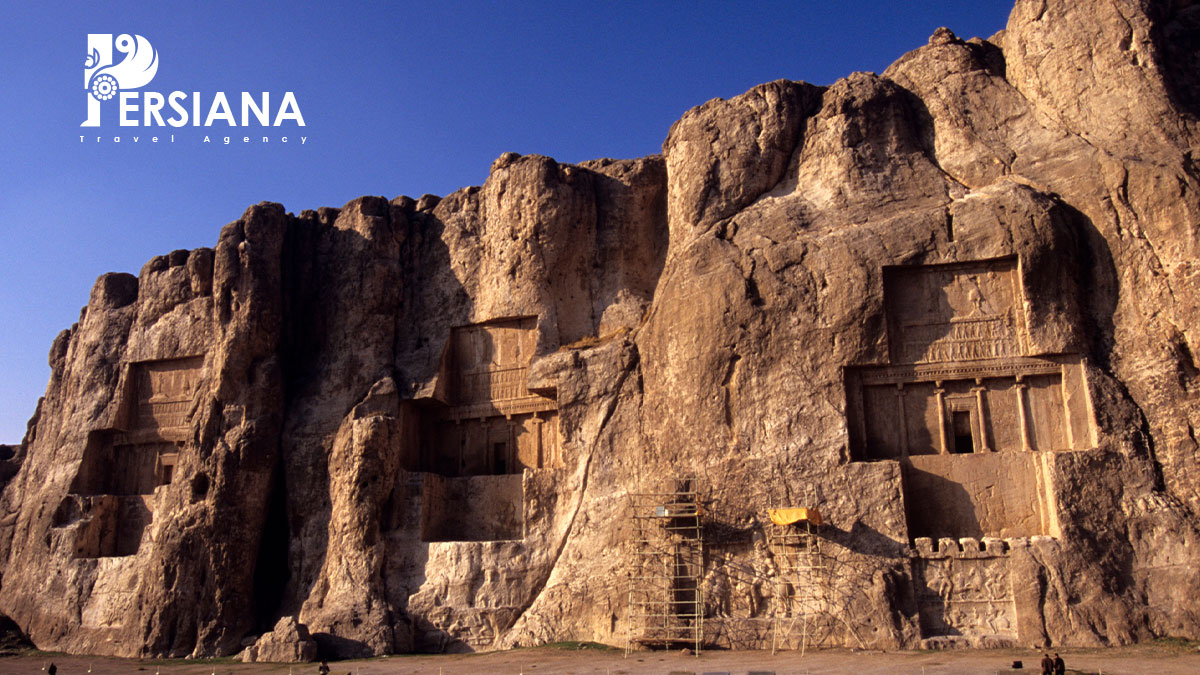
Of the 4 tombs exist in Naqsh e Rustam, only the tomb of Darius I has an inscription. In the upper branch of this tomb of Naqsh e Rustam, Darius is standing on a three-step platform in Persian clothes and with a bow in his hand, performing the ceremony. The image of Ahura Mazda is placed above his head and in front of him and Dariush holds his hand as a sign of respect for this image. The tomb of Xerxes is located to the right of the tomb of Darius I in Naqsh e Rustam, and except for the lack of inscriptions and some minor differences in the reliefs, it is quite similar to that tomb.
Of these four tombs, the tomb of Xerxes is the best preserved in Naqsh e Rustam. The tomb of Ardashir I is located to the left of the tomb of Darius I. The tomb of Darius II is the most western Achaemenid tomb of Naqsh e Rustam. The entrance to the tombs is square. These doors were locked in ancient times. To do this, two large pieces of stone were placed behind them and sealed with this device in Naqsh e Rustam.
The shape of the tombs is similar. The only difference between the tomb of Darius the Great and other kings is the cuneiform inscriptions. In this inscription of Naqsh e Rustam, Darius praises Ahuramazda, enumerates his conquests, and speaks of his thoughts. The corridor inside the tomb of Darius the Great is 18.72 meters long and 3.70 meters wide. In this tomb of Naqsh e Rustam, there are 9 stone coffins that have been dug in a row in the stone and belong to Darius the Great, the queen and his other relatives. The length, depth, width and thickness of these coffins are 10.2, 1.05, 1.05 m and 17.5 cm. These tombs double the glory and majesty of Naqsh e Rustam.
Zoroastrian Kaaba in Naqsh e Rustam
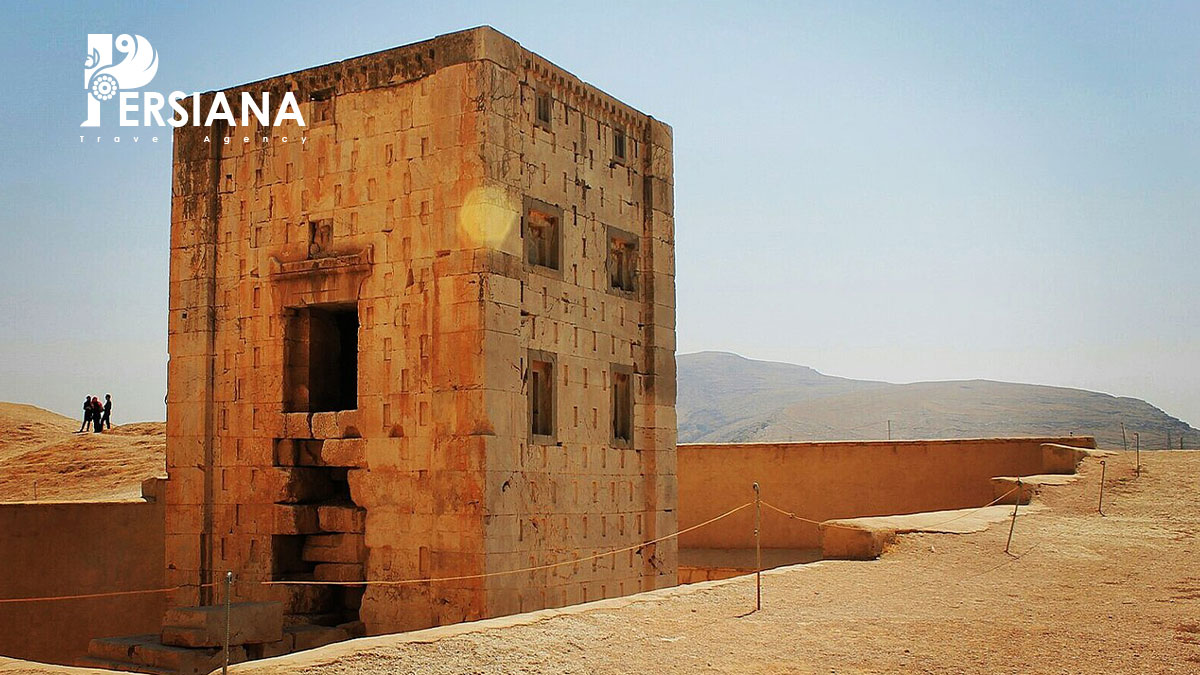
The Kaaba of Zoroaster is the name of a building in Naqsh e Rustam with a rectangular cube and a special architecture, which was mistakenly named the Kaaba of Zoroaster since the Arab invasion to Iran. They called this building the Zoroastrian Kaaba because they thought that every religion should have a pagoda or a center for itself. This building was built during the Achaemenid period and probably during the reign of Darius the Great in Naqsh e Rustam.
The Zoroastrian Kaaba of Naqsh e Rustam has an entrance above the ground and the remains of a staircase to access its only entrance. By 1937, the lower third of the building was buried in the ground. With the beginning of archeological excavations in Naqsh e Rustam in 1937, it was revealed that the building has a platform on its 3 sides (except the entrance). At the entrance, the rotation of the heavy and thick door heel indicates that the building is closed.
The Zoroastrian Kaaba of Naqsh e Rustam is made entirely of white and black limestone. Regarding the use of this building in Naqsh e Rustam, it has been said that the place where the Avesta book and government documents were kept is the place of the court treasure, fire temple, temple. Some historians have mentioned that the Avesta, written on 12,000 cowhides, was kept in this building in Naqsh e Rustam. Another group believes that this room was the tomb of Berdia, the son of Cyrus, who was killed by his brother Cambyses.
Others believe that the sacred fire was kept in this building, and some have said that it was an observatory. During the Sassanid era, very important government documents were kept in this building in Naqh e Rustam. But the exact function of the Zoroastrian Kaaba of Naqsh e Rustam is unknown.
Sassanid Inscriptions and Bas-Reliefs in Naqsh e Rustam
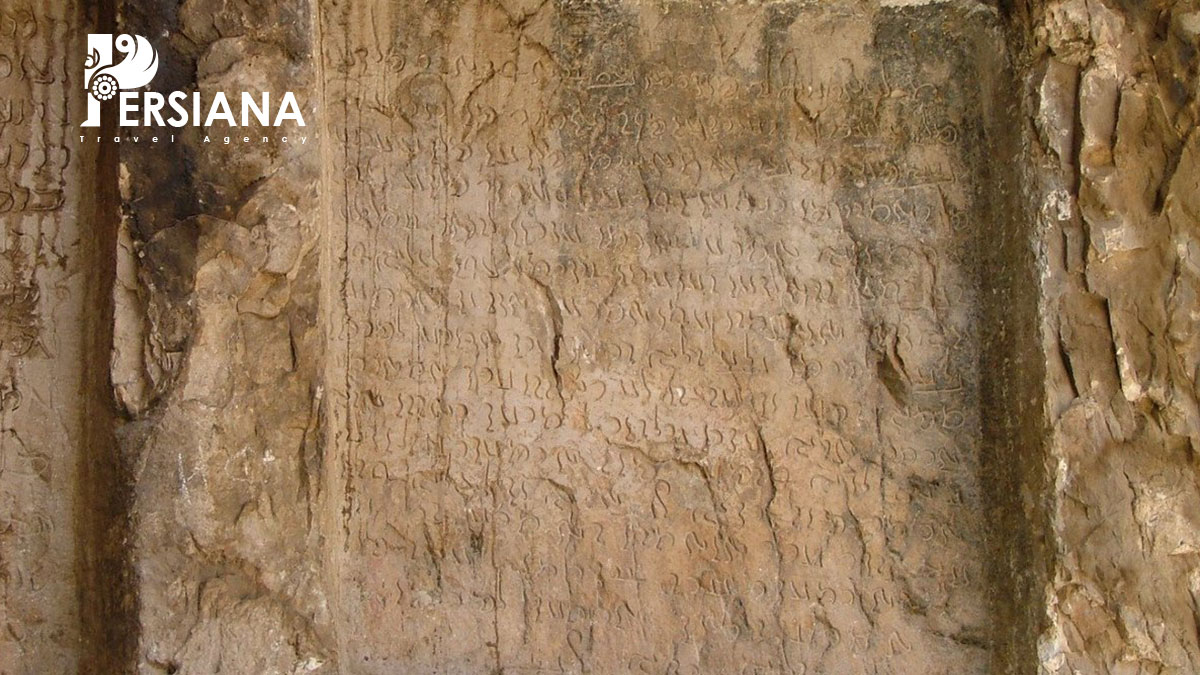
The Sassanid inscription is engraved in Naqsh e Rustam in 3 languages: Middle Persian (Sassanid Pahlavi), Parthian Pahlavi and Greek. The main issue of these inscriptions of Naqsh e Rustam is the historical events of the time of Shapur I during the Iran-Rome war, in which Valerian, the Roman emperor, was defeated and imprisoned in Bishabour in 262 AD.
Another inscription of Naqsh e Rustam has been engraved under the inscription of Shapur I in Parthian Pahlavi language and 19 lines, by the order of Kartir the great cleric. Kartir, while introducing himself and his titles, described the services he rendered in the cause of Zoroastrianism. The bas- reliefs of Sassanid period in Naqsh e Rustam are as below:
- Opposite Naqsh e Rustam, there is a part that was carved in the Sassanid period, but no motifs are engraved on it.
- In the eastern corner of the Naqsh e Rustam, there is another bas-relief that shows the scene where Ardeshir Babakan (right) receives the royal ring from Ahuramazda (left)
On the west side of Naqsh e Rustam is a bas-relief shows Narsi’s coronation. In this figure, Narsi receives the ring of power from Anahita (the goddess of water). - In the third relief of Naqsh e Rustam, Bahram II (298-276 AD), fighting and riding a horse, attacks the enemy.
- In the fourth bas-relief of Naqsh e Rustam, Shapur I is seen defeating the Roman emperor Valerian. This victory took place in 263 AD.
- There are two bas-reliefs under the tomb of Ardashir I in Naqsh e Rustam belong to Azar Narsi or Shapur Zolaktaf and Hormoz II.
- Below the tomb of Darius II and facing the Kaaba of Zoroaster, there is probably a role of Shapur II (379-309 AD)
- The oldest existing bas-relief in Naqsh e Rustam is related to the Elamite period and was later erased by Bahram II and replaced by his role and that of his courtiers, but some of the previous role remains intact.
Naqsh e Rustam is a historical monument that contains many bas-reliefs, a Zoroastrian building and some cuneiform inscriptions belong to three different eras. If you are eager to enter the ancient world of Iran, don’t miss Persiana Travel and Tourism Agency’s historical tours to Naqsh e Rustam.