

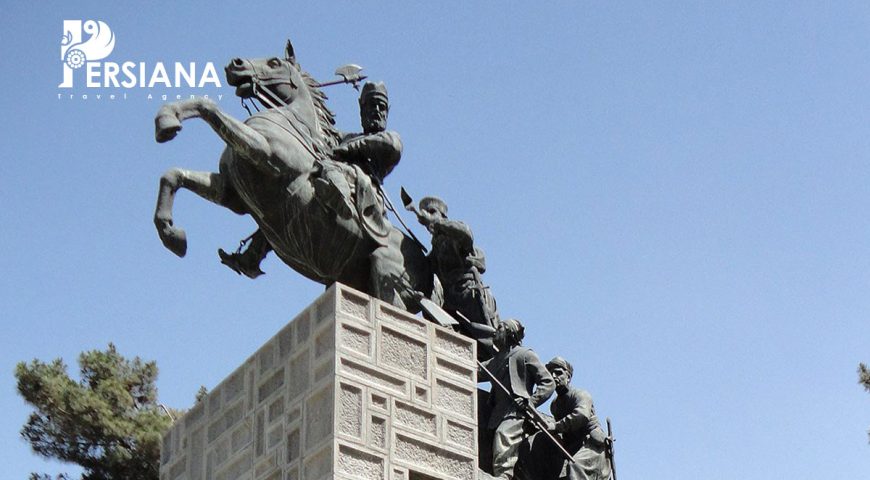
Tomb of Nader Shah
Tomb of Nader Shah is a building in the garden complex of Naderi Museum in Mashhad. This tomb was designed and built by Hoshang Sihon in memory of Nader Shah Afshar in 1963. Stay with Persiana Travel and Tourism Agency in this article to get familiar with this monument.
Introduction of Nader Shah Tomb
This building is in the garden of Naderi Museum in Mashhad, which was built by Hoshang Sihon in memory of Nader Shah. This complex has a central part which is the burial place of Nader Shah and two halls of the weapons museum. In the central part, there is a rare bronze statue on a horse. This statue was designed by Abolhasan Sediqi, a contemporary Iranian artist. It was cast in Italy and is now attached to the mausoleum.
During Nader Shah lifetime, he ordered the construction of a small tomb above Mashhad Street. This small mausoleum was built of clay and mud in 1732, adjacent to Chaharbagh Shahi and in front of Imam Reza’s shrine. At the end of the Qajar era (1917), Qawam al-Sultaneh built a new tomb for him in the place of one of the destroyed mausoleums of Naderi. Then his bones transported from Tehran to the said tomb.
The current tomb of him located on the northwest side of Shahada Crossroad (former Nadri). It is considered the most important tourist and historical place in the city of Mashhad after the shrine of Imam Reza.
This building is a garden with an area of 14400 square meters. This place includes a twelve-step platform, a grave, a tent-like covering over the grave, a high platform next to the grave with a statue of Nader Shah on a horse and three others following him, a book stall and two halls for the museum.
The cover of the tomb is completely like a nomadic tent, in which Nader was born and killed there. The covering of the inner walls of the mausoleum is also made of Maragheh ocher marbles to better evoke the murder of him inside the tent.
History of Nader Shah tomb

After the extinction of the Safavid dynasty and the dominance of Mahmud Afghan and Ashraf Afghan over Iran, Nader Shah Afshar, got into power. He was called “the last explorer of the East”, “Napoleon of Iran” and “Alexander II” in Europe. He was able to suppress the local claimants, the Afghans and the Ottoman Empire. Then, in 1735, he organized an assembly in the Mughan plain and called himself the king of Iran.
He chose Mashhad as the capital of Iran for the first time. He built his first tomb in this city in 1730-1732. After he officially became the king of Iran in 1735, he immediately set out to conquer India. When he returned from this trip, he decided to build another tomb for himself in this city.
Therefore, he ordered to bring large black marble stones from Dehkhwar ghan, Azerbaijan to Khorasan. Some of these stones weighed between 6 to 18 tons, and their transportation was very expensive and hard.
Finally, in the last years of his life, he built another building as a family tomb. It was called Khurshid Mansion, but his body was not buried in any of these three tombs. Head of Nader Shah Afshar was sent from Quchan to Herat after his murder in 1747. His headless body was also temporarily buried in one of these mausoleums, but later Agha Mohammad Khan Qajar moved it to Tehran.
For this reason, he did not have a mausoleum in the city of Mashhad for a long time. Qavam al-Saltaneh built a new mausoleum for him at the end of the Qajar period in 1917, on the site of one of the three destroyed Naderi tombs. His bones were moved there from Tehran. This building was standing for a long time, and at the end of 1956, the Iranian National Artifacts Association decided to build a mausoleum in the name of Nader Shah. The construction of it started in 1957 and ended in 1963.
The architecture of Nader Shah tomb
The current tomb of this king is in a garden with an area of 14,400 square meters. The main building of the mausoleum has an area of 12,000 square meters and consists of four parts. The first part is a hall with a length and width of 5.15 x 4.8 meters. The second part is the main space of the mausoleum which is 15 x 15 meters. The two last parts are two sides with approximately 4 meters wide and 5.2 meters high.
There are 16 solid stone columns with a height of 26.2 meters around the tomb. The ceiling of this monument is more than 6 meters high. In this mausoleum, there is a twelve-step platform, a grave, a tent-like cover over the grave, a high platform next to the grave with a statue of Nader Shah on a horse with three others following him, a book stall and two halls as a museum, one for exhibition. There are war weapons from the reign of Nader Shah as well as the weapons of the pre-Nader period.
The design of the building is based on square and triangle shapes. The square-shaped hall consists of two red stone walls, closed and open in the columned part. The tombstone is located in the corner of this square under the shelter of the two walls. The open space of the hall is a scene of war, defense and attack, and the red color of the two walls means war. The design of the columns around the hall evokes a war helmet. The materials of this building are rough and hard granite rocks of Mashhad. In the garden around the mausoleum, there are many
secondary buildings such as meeting hall, library, bathroom.
The designer of the building was engineer Hoshang Sihoun. The sculptures were made by the late artist Abolhasan Sedighi. The construction date of this building lasted from 1957 to 1963.
Naderi Museum in the Tomb of Nader Shah

Naderi Museum is located in the main part of the tomb and has two halls.
Hall number one
it is dedicated to all kinds of weapons from the Afshari period, equestrian equipment such as saddles from the Afshari period to the Qajar period. Moreover, it has several manuscripts including the history of Naderi’s world-discoverer and two swords belonging to Nader. The walls of hall decorated with paintings from Nader’s battle scenes in the Kernal War.
Hall number 2
this hall was added to the complex in 1994. It displays all kinds of coins, ancient and anthropological objects, dishes and other donated objects from the Safavid period to the present day. In addition to the objects inside the museum, the entrance to the main hall also decorated with war cannons. Naderi Museum is affiliated to Khorasan Cultural Heritage Organization.One of the special features of this building is the
design of watercourses, ponds and streams. All of them are designed on the basis of an Iranian garden. The design of the building is based on two main geometrical shapes, square and triangle, from the Kharay stone of Mashhad.
In this article Persiana Travel and Tourism Agency gave you a brief introduction of Nader Shah Tomb. As we mentioned this place has a very magnificent architecture. Moreover, Naderi Museum next to Nader Shah’s tomb doubles the importance of this monument. This museum also has a very interesting architecture and precious objects that attract many visitors.